Juan
Legado en los huesosJuan is Rosario’s husband, the father of their daughters, and her partner in the bakery they built together. His story turns on a painful gap between his affection and his actions: he recognizes that Rosario is changing, but fear and avoidance repeatedly keep him from confronting her. Later disclosures about the birth and death of her newborn twin make his silence, and his failure to protect Amaia as a child, part of the family’s history of concealment.
Identity and family life
Juan remembers falling in love with Rosario when she came from San Sebastián to spend a holiday in Elizondo, Amaia’s hometown. He regards himself as fortunate to have married her. She gave birth to Flora and Rosaura, and, during the period when he is first shown searching for her at night, she is pregnant again. He sees her as an affectionate mother to their older girls and an accomplished business partner, more naturally gifted at commerce than he is.
The bakery is both their shared work and a measure of their success. Rosario works there alongside Juan, and he credits her with helping the business grow beyond what he had imagined. At home, however, he understands little about her private life. He describes her as strong and rarely given to complaint, but also as increasingly distant from neighbors and other mothers. Elena, once her friend, is no longer close to her; when Juan asks about the loss, Elena says the friendship is over. Rosario’s isolation becomes one of several changes he notices without knowing how to interpret.
Marriage under strain
One night Juan reaches across the bed for Rosario and finds only a space that has lost its warmth. He searches the house barefoot, checking the girls’ room, the kitchen, the bathroom, and the balcony, at first hoping she has fallen and needs help. The alternative is harder to bear: she has slipped out while he slept, and he expects her to return before dawn, cold and silent. He smells the trace of her hair on the pillow and wonders what is happening between them.
The absences are part of a wider pattern. Rosario takes long walks alone, goes out at night, keeps silent, and sometimes gives evasive explanations for where she has been. When Juan suggests that she might let him accompany her, she answers with anger and chilling distance. He does not know where she goes or with whom; what he does know is the returning cold that seems to leave an invisible boundary between them in bed. He waits awake for the key in the lock, then postpones the conversation he has promised himself he will have.
Juan seeks a doctor’s opinion because he feels out of his depth. Having attended Rosario’s previous pregnancies and births, he considers himself one of the people who knows her best, but admits to himself that he is no expert on women’s psychology. The doctor interprets the night outings, secrecy, and insistence on solitude as signs of depression, and suggests that the valley’s darkness and prolonged rain may be contributing. He also warns that a demanding pregnancy could intensify Rosario’s pressure to be a perfect wife and mother, and recommends that Juan arrange help with the girls, the bakery, or the house.
Rosario rejects the suggestion as an insult. She insists that she can manage the house and the girls, and treats the prospect of another woman helping as an intrusion into her home. When she threatens to return to San Sebastián if Juan interferes, he backs down. Her anger lasts for days; afterward, life resumes its familiar outward shape, with Rosario still going out and Juan still waiting. He privately calls himself cowardly, comparing his fear of her reaction to a child’s fear of a stern mother. Relief at hearing her return replaces the conversation he knows they need.
Work, pride, and the naming dispute
By spring 1980, the bakery has acquired a mechanical mixer. The machine has been in use for only a couple of months, but production has risen enough for the couple to accept customers they could not previously serve. Juan recognizes the practical success, while remembering that Rosario had predicted the improvement.
His thoughts also return to the earlier pregnancies and to a preference he now recognizes as foolish: he had wanted a son to carry on the Salazar name. With Flora’s birth he had cared less, but Rosaura’s birth disappointed him, though he concealed that feeling from Rosario. His mother had warned him to show gratitude rather than sulk, reminding him that a daughter was worth as much as a son. The episode exposes a traditional expectation Juan held even as he loved his family.
A list of possible names for boys and girls, made with Rosario during the earlier pregnancies, remains in a bakery drawer. Juan had chosen the names for their daughters from it. When he raises the question of naming the coming baby, Rosario snatches up the old list, crushes it, throws it at him, and runs from the bakery. Juan notices its creases, torn corner, and fresh marks from her hands, and regrets pressing the subject. When he tries to understand her muttering about a list of dead people, she tells him not to be afraid and calls it a game. He is left frightened by the gap between her ordinary tone and what he has just heard.
The birth and the record of loss
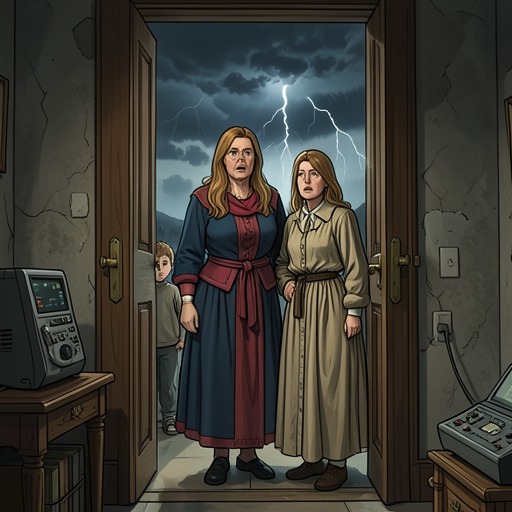
On June 23, 1980, during a violent storm in Elizondo, Juan waits through Rosario’s labor at home. Around nine in the evening, she sends him to take the older girls to his mother’s house. She has summoned Dr. Juan Hidalgo herself. The birth continues for hours; the power goes out, and Juan, overwhelmed by Rosario’s screams and the silence that follows, kneels by candlelight in the bathroom to pray where no one will see his tears. Rosario had refused the hospital and an ultrasound despite the risk of a twin pregnancy, and had not allowed him to tell his family that they were expecting two babies.
When Dr. Juan Hidalgo calls him out, Juan asks whether Rosario is all right. The doctor assures him that she and both babies are well: two strong, healthy girls. Juan takes the doctor’s hand, smiles, and asks to see them. Told to wait while the doctor’s sister finishes preparing Rosario, he jokes that he seems capable only of making girls and offers the doctor a drink. His delight at the news stands in stark contrast to what the family will later learn about the twins.
Years afterward, Amaia finds the obstetric records. They list earlier natural births in 1973 and 1975, then a natural twin birth in 1980 with no complications; the two girls are recorded as apparently healthy, but no names are entered. When Amaia asks whether a newborn’s death would have been documented, she is told that a death in the valley should have a certificate. A document is found for a newborn daughter of Juan and Rosario, with the recorded cause given as cot death. The record and the family’s recollections do not resolve what happened: there are irregularities, and the evidence from the remains Amaia is investigating raises further questions about the birth and death.
The family had been told that a baby girl was born dead, but had not been told that there had been another twin. In their later discussion, they recall that the coffin was closed and that they did not see the child’s body. They believe Rosario disclosed the death because she needed the family to bury the baby there. One relative recalls that the relationship with Rosario changed after the little girl died. These accounts establish the concealment surrounding the birth, but do not by themselves settle the circumstances of the infant’s death or the identity of the remains.
Fatherhood, silence, and retrospective judgment
Juan’s later significance is inseparable from Amaia’s judgment of his conduct when she was a child. Rosaura recalls that one night Rosario came to the girls’ room believing Amaia was in Rosaura’s bed and said something that made Rosaura understand the danger Amaia faced. Rosaura began watching Rosario and let Amaia sleep beside her, but kept the memory secret. When she finally tells Amaia, Amaia says that the children could do nothing; the adult responsible was their father, who should have defended her and did not.
Rosaura resists that judgment, remembering Juan as a good man who wanted the family to function. Amaia’s account is harsher: she says he protected Rosario and made a nine-year-old leave home, separating her from her father and sisters. His earlier fear of confronting Rosario thus acquires consequences beyond his marriage. The man who searched the house hoping his wife had merely fallen, who prayed during her labor, and who smiled at the news of two healthy daughters is also remembered as a father who failed to intervene when his child needed protection. The novel leaves that contradiction intact: Juan’s care is real, but care without resistance could not keep the family safe.